BIOCUF

Italian Partnership Project

Project Code: CETP-2023-BIOCUF Duration: 2024–2027 Funded by CETPartnership

Biomimetic CO₂ Fixation and Utilization for Formate Production

Cicci Research contributes advanced environmental control, gas management, spectroscopy and real-time monitoring technologies for next-generation carbon capture and utilization research.

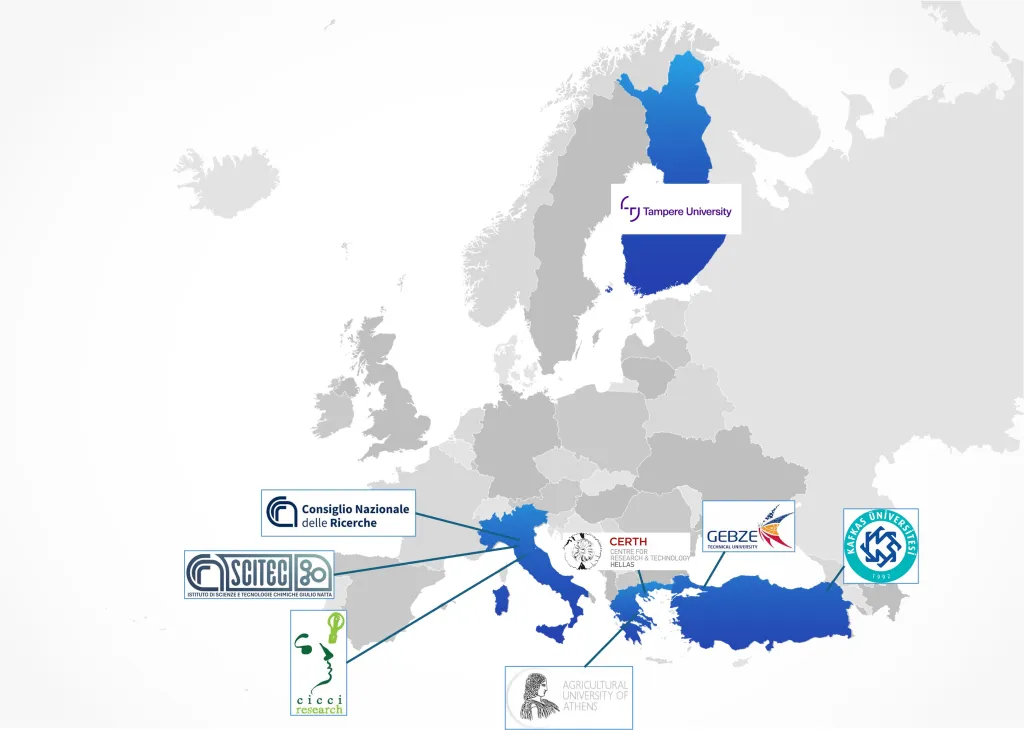
BIOCUF map

Transforming CO₂ into Valuable Chemicals

BIOCUF (Biomimetic CO₂ Fixation and Utilization for Formate Production) is an international research project developing innovative technologies for carbon capture and utilization.

The project combines advanced enzymes, electrochemical systems and process engineering to capture carbon dioxide and convert it into formate, a valuable platform chemical and energy carrier.

Cicci Research contributes advanced instrumentation, environmental control technologies, gas management systems, spectroscopy and real-time monitoring tools to support the development and validation of these next-generation carbon capture processes.

Project Facts

Focus CO₂ Capture & Utilization
Target Product Formate
Technology Enzymatic Conversion
Cicci Contribution Instrumentation & Monitoring
Dissemination ISOPHOS Summer School

Contributions from Research Partners

BIOCUF combines expertise in enzymatic CO₂ conversion, photocatalysis, cofactor regeneration and process engineering. The following activities summarize the scientific progress achieved by the research partners during the current reporting period.

Cicci Research

Reactor Engineering, Automation & Pilot Integration

Cicci Research provides the experimental and digital infrastructure that enables the integration of BIOCUF technologies into a scalable pilot platform. Building on its ARKEO ecosystem, the company adapted its environmental chambers into controlled reactors for cofactor-regeneration and future enzymatic CO₂ conversion experiments.

The developed system provides precise control of temperature, atmosphere, illumination and future inline spectroscopic monitoring. Dedicated open TCP/JSON APIs were also developed, allowing external software to control reactor operation and facilitating future integration with the BIOCUF TRL5 pilot system.

In parallel, Cicci initiated FAIR-data integration workflows and NOMAD compatibility, ensuring that experimental datasets generated within BIOCUF can be shared, reused and integrated into open scientific repositories.

Cicci also leads dissemination activities through the ISOPHOS international school and hands-on training sessions, helping transfer BIOCUF technologies to researchers, students and industrial stakeholders.

Explore Contributions Download Annual Report

CNR-SCITEC

Enzymatic CO₂ Conversion & Formate Production

The team at CNR-SCITEC is investigating biological pathways for converting captured CO₂ into formate through Formate Dehydrogenase (FDH) enzymes. Their work focuses on identifying robust enzyme systems capable of operating efficiently under conditions compatible with future industrial implementation.

During the reporting period, four different FDH enzymes were biochemically characterized and compared. The researchers evaluated catalytic activity, kinetic constants, sensitivity to pH variations and tolerance to organic solvents. These studies provide essential information for selecting the most suitable enzyme systems for integration into the BIOCUF reactor.

SCITEC also demonstrated the use of water-processable nanoparticles capable of regenerating methyl viologen, a promising cofactor analogue for enzymatic formate production. This work establishes the basis for coupling photocatalytic regeneration systems with biological CO₂ reduction pathways.

The results obtained during the first project phase guide the optimization of reaction conditions and the selection of enzyme systems that will be validated in the integrated BIOCUF reactor during the next stages of the project.

Download Quaderno di Laboratorio Download Presentation Slides Download Annual Report

CNR-ICCOM

Photocatalytic Cofactor Regeneration for CO₂ Conversion

The team at CNR-ICCOM is developing light-driven systems to regenerate the cofactors required for enzymatic CO₂ conversion into formate. Their work focuses on sustainable alternatives to conventional chemical regeneration methods, enabling the use of solar energy to drive the reduction process.

Key achievements include the synthesis and characterization of rhodium-based molecular catalysts capable of transferring hydride equivalents for NADH regeneration, as well as the investigation of organic photosensitizers and their interaction with catalytic mediators through spectroscopic and electrochemical techniques.

Experimental studies demonstrated successful light-induced cofactor regeneration under simulated solar irradiation and confirmed efficient charge transfer between photosensitizers and catalytic mediators. Parallel activities explored alternative regeneration pathways based on methyl viologen and semiconductor photocatalysts.

The research provides the foundation for integrating photocatalytic cofactor regeneration directly with enzymatic CO₂ reduction, enabling a fully solar-powered carbon utilization process. ICCOM aims to deliver stable photoelectrocatalytic systems suitable for integration into the BIOCUF pilot reactor.

Download Presentation Slides Download Annual Report

Supporting Sustainable Carbon Utilization

BIOCUF combines biomimetic chemistry, environmental control, gas management and advanced monitoring technologies to develop innovative pathways for carbon capture and utilization.

🌍

Carbon Capture

Development of technologies capable of capturing carbon dioxide and converting it into useful chemical products.

⚗️

Formate Production

Investigation of efficient pathways for converting CO₂ into formate, a valuable chemical feedstock and energy carrier.

🔬

Research Infrastructure

Creation of advanced instrumentation and monitoring tools supporting next-generation carbon utilization research.

📊

Data-Driven Science

Continuous acquisition and analysis of environmental, gas and spectroscopic data to accelerate research.

From Environmental Control to Scientific Insight

Cicci Research contributes a complete experimental ecosystem integrating environmental chambers, automated gas handling, optical spectroscopy and real-time monitoring into a single research platform.

3 Integrated Sensors
24/7 Continuous Monitoring
5–85°C Temperature Control
20–80% Humidity Control