SPECTRA
Multispectral Solar Photoreforming Device for Selective Depolymerization of Mixed Plastics
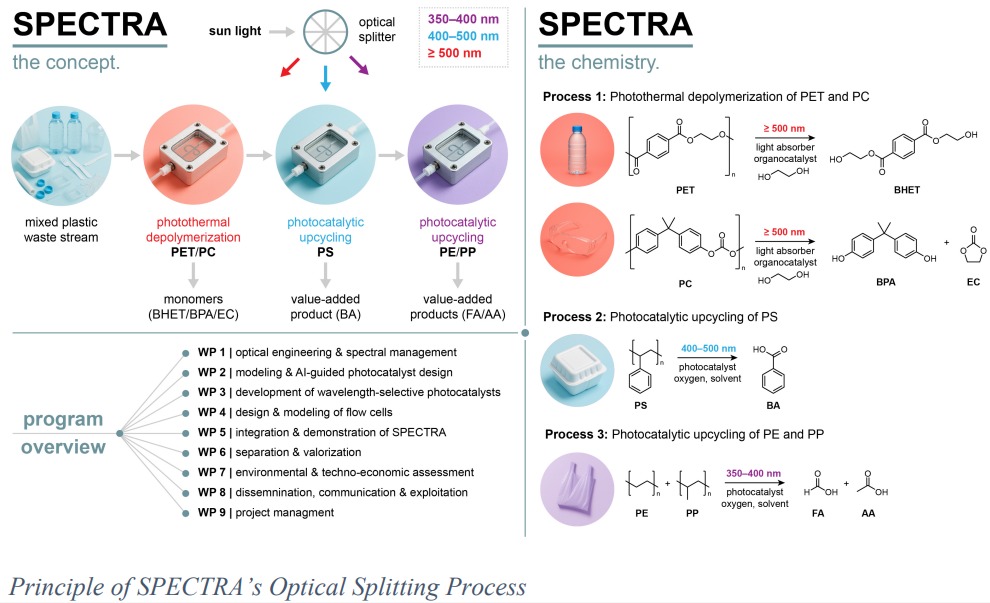
SPECTRA addresses Area 1 of the EIC Pathfinder Challenge 2025 “Waste-to-Value Devices: Circular Production of Renewable Fuels, Chemicals and Materials”, targeting new device concepts for the circular conversion of plastic waste into renewable fuels and chemicals.
SPECTRA develops a breakthrough solar-driven photoreforming device that converts mixed and non-recyclable plastics, including polyethylene (PE) and polypropylene (PP), into renewable fuels and high-value chemicals. Conventional recycling cannot handle such polymers due to their inertness and the need for sorting, high temperatures, and complex purification, leading to poor circularity and low-value outputs.
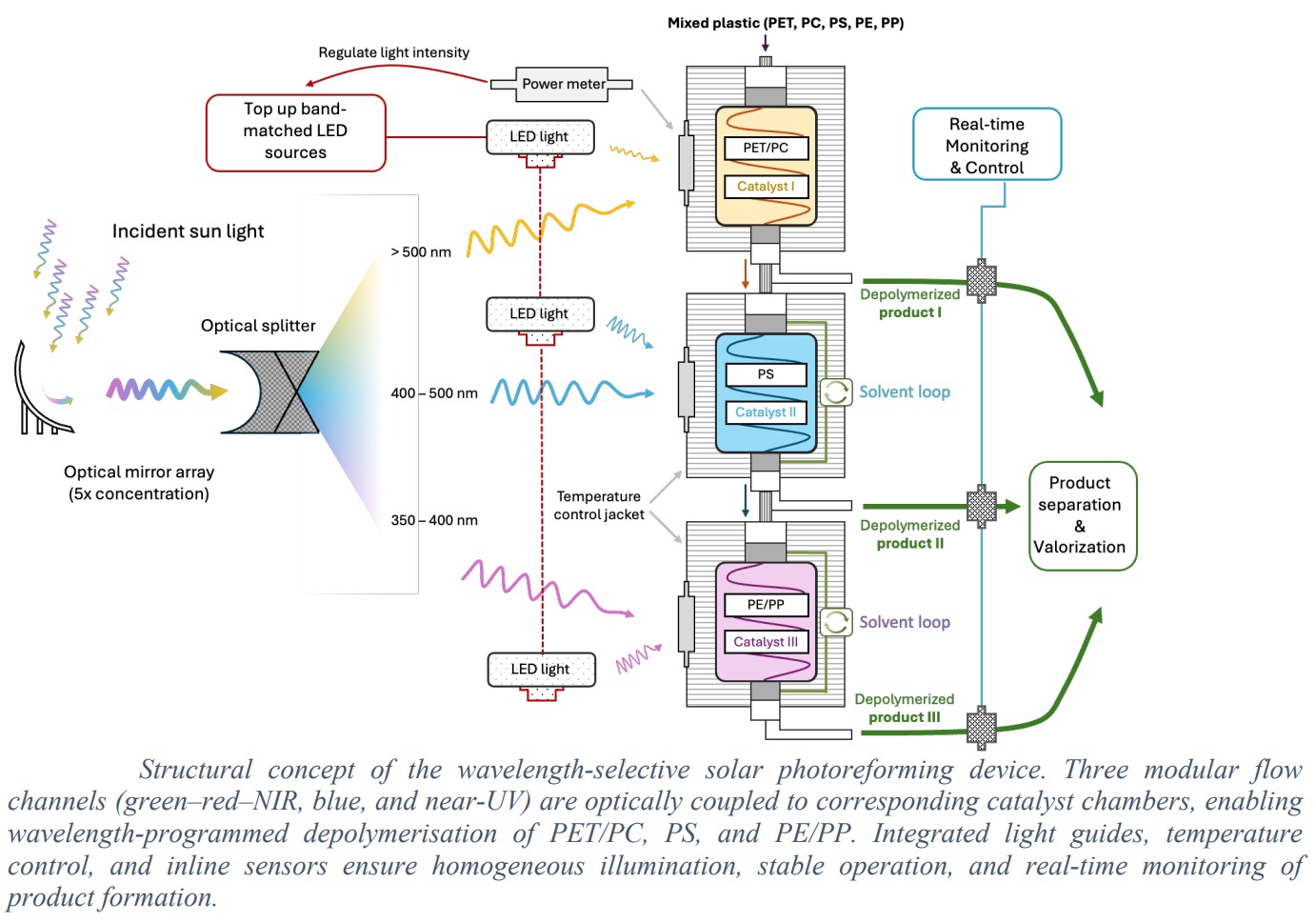
SPECTRA introduces a multispectral waste-to-value platform combining optical splitting, wavelength-matched photocatalysts, flow-reactor engineering, and LED-assisted illumination. Incoming sunlight is divided into green-red, blue, and near-UV channels, each directed to a dedicated reactor containing a spectrally tuned photocatalyst. Green-red light drives photothermal solvolysis of PET and PC, blue light promotes benzylic oxidation of PS, and near-UV light enables selective C–C bond scission in PE and PP. Integrated LED modules provide controlled top-up light, ensuring 24-hour continuous operation and precise reaction selectivity independent of solar fluctuations.
The coupled photoreforming–separation system will demonstrate >90 % conversion selectivity and >95 % product purity at lab scale (TRL4), achieving direct depolymerisation of mixed plastics without prior sorting or downstream purification.
SPECTRA establishes a new class of solar–photonic upcycling devices, merging optical design, catalysis, and process intensification to unlock circular, low-carbon pathways for renewable fuels and chemical production. The project directly supports the EIC Pathfinder Challenge “Waste-to-Value Devices”, the EU Circular Economy Action Plan, and the Industrial Carbon Management Strategy.
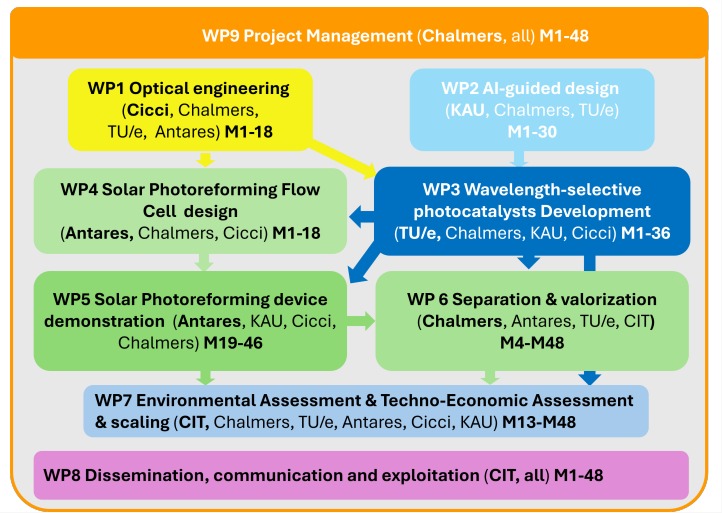
Consortium
Coordinator
Partner
Partner
Partner
Partner
Partner